Wolf Territoriality
Never Cry WolfWolf Territoriality, as Farley Mowat describes it, is a practice of settled range, recurring boundary maintenance, and recognition between neighboring wolves. Its clearest demonstration comes when Mowat marks a small claim inside the range of the wolf family he is observing. The leading male responds not with an attack but with a careful inspection and a counter-marking of the line. The episode turns territory from an abstract feature of wolf life into a negotiated boundary that also changes how Mowat can live and work among the animals.
A Settled Range and Its Boundaries
Mowat’s observations overturn the belief that wolves are generally nomadic roamers. His wolfish neighbors appear settled, possessing a large, permanent estate with definite boundaries. The family’s territory covers more than a hundred square miles. A river forms one edge, but the other limits are not defined by obvious geographic features; the boundaries are instead indicated in what Mowat calls wolfish fashion.
The wolves maintain those lines through scent marking. Roughly once a week, the clan makes a circuit of its land and refreshes the markers, a routine Mowat compares to a ceremonial beating of the bounds. Two other wolf families hold adjoining territories. Although their estates meet, Mowat sees no evidence of quarrels or disputes between their owners. He therefore suspects that the regular rounds function at least partly as ritual, rather than as a response to active conflict. That interpretation remains his own: the repeated marking is observable, while the wolves’ purpose cannot be directly confirmed.
Territorial possession also shapes the family’s movements. The males leave in the evening to hunt, ranging widely but, as far as Mowat can tell, remaining within the family’s limits. His estimate is that a normal night’s hunt covers thirty or forty miles; when food is scarce, their return may be delayed until the afternoon. These distances describe substantial movement within a home range, not evidence that the wolves are constantly wandering without an established base.
Mowat Marks a Claim
Once he recognizes how strongly the wolves attend to boundaries, Mowat decides to use that knowledge to make them acknowledge his presence. One evening, after the wolves leave on their nightly hunt, he stakes out an area of about three acres around his tent. His proposed territory includes a hundred-yard stretch of the path the wolves use. The experiment is at once practical and social: he hopes to be noticed, but has little certainty about how a wolf will interpret a human claim laid across its route.
Making the boundary legible takes most of the night. To avoid having the claim overlooked, Mowat marks stones, moss clumps, and patches of vegetation at intervals no greater than fifteen feet around its circumference. He repeatedly returns to the tent for tea, finishes before dawn, and waits for the hunters to come home. His careful preparation is based on observing the wolves’ own method, though he has not yet learned how to perform it in a way they will recognize.
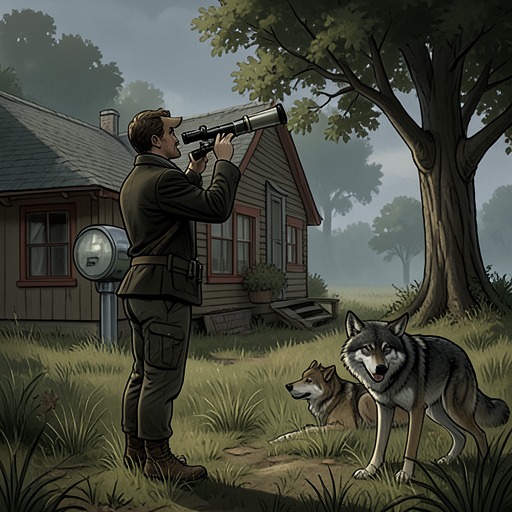
At 8:14, according to his wolf log, the leading male comes over the ridge and approaches along the path. The wolf has usually ignored the tent, but stops abruptly where Mowat’s line crosses the trail. From about fifty yards away, Mowat watches through binoculars as the animal sniffs one of the marked bushes. After hesitating, it backs away, sits, and looks directly toward the tent and Mowat. The pause makes the boundary visible as a problem to be assessed: the wolf has encountered an unfamiliar marker, and Mowat cannot know what response will follow.
Counter-Marking and Recognition
The male eventually gets up, sniffs the marker again, and begins a systematic circuit of the claimed area. At each boundary marker it pauses to inspect the object, then places its own mark on the outer side of the grass clump or stone. In this way, the wolf does not simply erase Mowat’s line. It traces the perimeter and marks its outside, responding to the claim through the same boundary practice that first prompted it.
The circuit takes no more than fifteen minutes. When it is complete, the male rejoins the path at the point where it leaves Mowat’s enclosure and continues home. Mowat concludes that he has made a mistake in his marking technique: the wolf applies its marks economically and completes the circuit without needing to replenish them. The detail gives the encounter its quiet reversal. Mowat has copied the appearance of wolf boundary-making, but the male’s more efficient counter-marking demonstrates how little he understands of its practical execution.
The episode establishes neither a human legal title nor a fully explained agreement. What it provides is an observed response: the wolf investigates the marks, adds its own along the perimeter, and departs. Mowat had feared that his intervention might violate an unknown wolf law, but the encounter ends without the confrontation he anticipated. Its meaning is conveyed through behavior rather than speech, and his interpretation remains grounded in the sequence he has watched.
The Enclave and the Limits of Interpretation
After this boundary has been formally established in Mowat’s account and ratified by the wolves, his small enclave remains inviolate. No wolf again trespasses on the domain. Individuals passing by sometimes stop to freshen the marks on their side of the line, and Mowat follows suit as best he can. The repeated reciprocal gestures turn the initial experiment into a continuing routine. For Mowat, the practical consequence is substantial: his doubts about personal safety recede, allowing him to concentrate on observing the wolves.
The account presents territoriality as both spatial and relational. A range has measurable scale, a river can define one edge, and a path can pass through a human tent’s surroundings; yet the other boundaries become legible through recurring acts of marking. Mowat’s claim matters because the wolves respond to it, while their counter-marking shows that his imitation does not make him an authority on their system. The enclave’s later security rests on a pattern of observed behavior, not on a claim that Mowat can read every intention behind it.
The limits of his knowledge remain important. He can report weekly rounds, adjoining territories, a particular male’s inspection, and the absence of later trespassing. He cannot establish whether boundary maintenance is chiefly practical, ritual, or both; his suggestion that it may be ritual is explicitly an inference from the lack of visible disputes. The episode therefore resists turning one encounter into a universal account of wolf behavior. Its significance lies in how close observation revises an inherited image of constantly roaming animals while showing Mowat himself learning, imperfectly, to live within a territory that was already occupied.